
Could 5–10 minutes of finger exercises a day help support cognitive function?
Your brain benefits from challenge, repetition, and coordination. Finger exercises are a simple way to bring those elements into your day, no equipment required.
Research suggests these exercises may support cognition and daily function, especially when practiced consistently. The strongest effects have been seen in people with mild impairment, reinforcing an important prevention principle: the earlier you start supporting brain health, the better.
They are not a cure or treatment for Alzheimer’s disease or cognitive decline, but they may be a practical addition to a broader brain health routine.
At multi-award-winning Fountain Life, prevention means acting before problems become life-altering. Nearly 1 in 4 Members show accelerated brain aging at baseline using AI MRI. Among those Members, 46% reverse accelerated brain aging, with measurable improvements linked to memory and cognitive performance.
What the research suggests
A systematic review of 11 randomized trials, including more than 1,200 older adults, found that regular finger-exercise programs led to significant gains in cognition and daily function [2]. On average, participants saw about a 1–1.5 point improvement on cognitive screening tools such as Mini-Mental State Examination (MMSE) and Montreal Cognitive Assessment (MoCA), along with better scores on daily living scales.
The effects were strongest in people with mild impairment, suggesting that earlier practice may be especially helpful [2].
In one trial of 232 older adults with an average age of approximately 75, a daily 30-minute finger-training routine for 30 days significantly alleviated Mild Cognitive Impairment (MCI). By the end of the study, participants’ mental test scores improved markedly compared to controls [3].
In dementia-care settings, even passive finger exercises, such as gentle finger stretches and taps, have been associated with meaningful improvements in everyday abilities [5].
Taken together, these findings suggest that finger exercises may produce measurable brain benefits. They are not a cure, but they may serve as a helpful brain workout that supports neuroplasticity, cognition, and daily function.
Brain mechanism
Fine finger movements activate multiple brain networks and trigger plasticity [2][5].
Each tap or stretch engages the motor and sensory cortex. More coordinated patterns also involve the cerebellum and frontal circuits [1][2], which help with timing, sequencing, and executive control.
The hands occupy a large area of the brain’s motor map. That means small, precise finger movements can create meaningful brain activation.
Over time, repeated activation may help strengthen these circuits. Physical activity is also known to raise brain-derived neurotrophic factor, or BDNF, and other growth proteins involved in learning and memory. Finger exercises may help “tune up” these pathways by combining movement, focus, rhythm, and coordination [4][5].
This is why coaches and therapists often encourage simple finger exercises as a low-cost, low-risk way to keep the brain engaged. They are not a substitute for medical care, but they can complement other healthy habits in preserving mental sharpness [2], including exercise, nutrition, sleep, and social connection.
Try this 5-10 minute finger exercise routine

Aim for 5–10 minutes, once or twice daily. Move slowly at first. As the exercises become easier, increase your speed or add more complex patterns.
These are the same patterns used in cognitive-health studies:
- Sequential thumb taps: Touch your thumb to each fingertip in order (index, middle, ring, pinky), then reverse (pinky→index). Go slowly at first, then speed up as you get comfortable. This simple tap sequence challenges coordination.
- Fist-open repetitions: Make a tight fist and then fully open your hand, spreading fingers wide. Repeat 10–15 times with each hand. This works finger flexors and extensors and helps mobility.
- Crossed-hands swap: Hold one hand in a fist and the other open. Then quickly swap positions (fist ⇄ open) back and forth. This alternation boosts bilateral coordination.
- Number-counting patterns: While tapping fingers (or alternating hands), silently count or say patterns (“1–2–3–4, 1–2–3–4…”). Combining a counting task with tapping adds a mental challenge on top of the motor activity.
Make it a daily habit
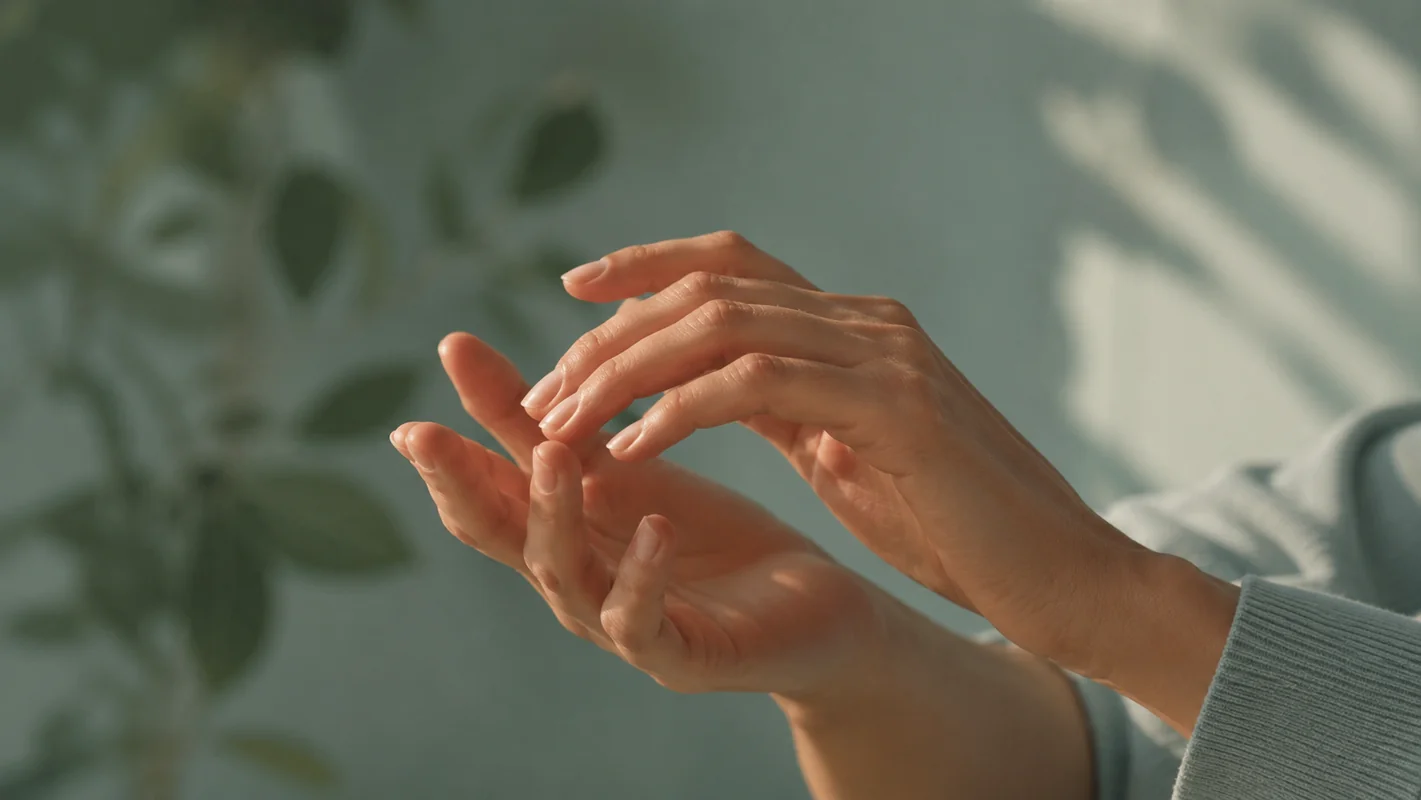
The key is consistency. Try pairing your finger exercise routine with a moment already built into your day:
- Before morning coffee
- After brushing your teeth
- During a midday break
- Before meditation or breathwork
- While sitting quietly in the evening
As the exercises get easier, keep challenging your brain by changing the rhythm, reversing the sequence, alternating hands, or adding a counting pattern.
Sources: Peer-reviewed studies confirm that Alzheimer’s and MCI patients show slower, less regular tapping (correlated with hippocampal atrophy) [1], and that finger-exercise programs significantly improve cognition (MMSE/MoCA) and daily living scores [2][3][5]. The findings above are drawn from these systematic reviews and trials.
- [1] Delayed and More Variable Unimanual and Bimanual Finger Tapping in Alzheimer’s Disease: Associations with Biomarkers and Applications for Classification - Vincent Koppelmans, Marit F.L. Ruitenberg, Sydney Y. Schaefer, Jace B. King, John M. Hoffman, Amanda F. Mejia, Tolga Tasdizen, Kevin Duff, Madeleine Hackney, 2023
https://journals.sagepub.com/doi/abs/10.3233/JAD-221297 - [2] Finger exercise effects on cognitive functions in older adults with MCI/AD/dementia: A systematic review and meta-analysis of randomized controlled trials - ScienceDirect
https://www.sciencedirect.com/science/article/pii/S2949834123000338 - [3] [4] Finger exercise alleviates mild cognitive impairment of older persons: A community-based randomized trial - ScienceDirect
https://www.sciencedirect.com/science/article/abs/pii/S0197457222001628 - [5] Investigation of the effects of different rehabilitation approaches in elderly individuals with mild cognitive impairment | BMC Geriatrics | Springer Nature Link
https://link.springer.com/article/10.1186/s12877-025-06946-x